Pollarise: Building an Interactive Social Polling Platform for Real-Time Community Engagement
A scalable SaaS polling platform on Next.js, Node.js and MongoDB, built to turn opinion-sharing into a fast, social, mobile-first experience rather than a survey form.

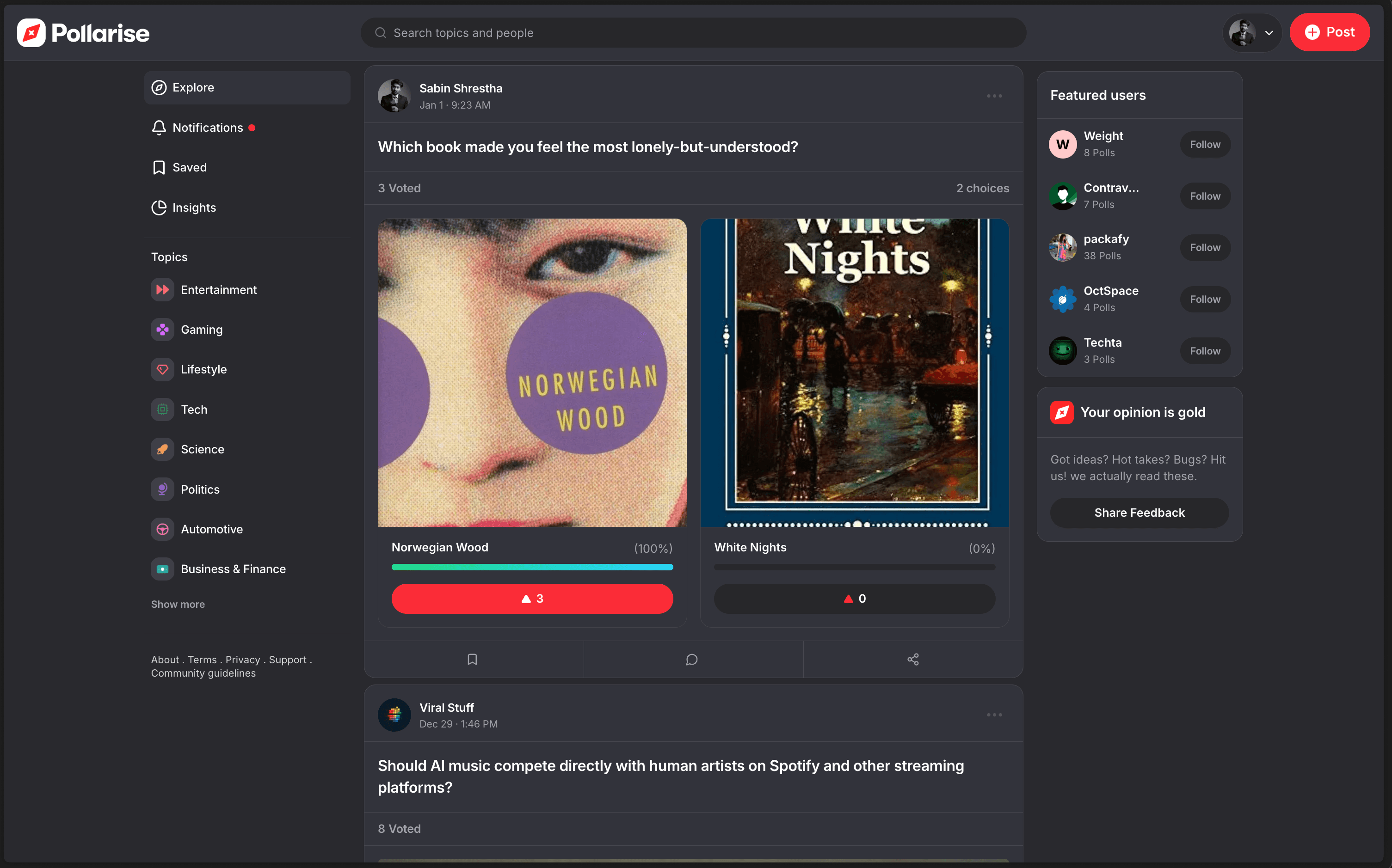
Pollarise — a social polling platform for creating polls, gathering opinions, and visualizing results in real time.
Client problem #
Most polling tools are built for surveys, not conversations: complex setup, poor mobile experience, limited customization, basic result visualization, and little sense of a community around the responses. The brief was to build something people would actually want to create and share — a poll that feels like starting a conversation rather than filling out a form — and to build it as a scalable SaaS product from the start, not a one-off voting app.
Vision & objectives #
The platform needed to let anyone create a question in seconds, share it with a community, discover public discussions, and see results visualized clearly — with real-time interaction, strong SEO on public polls, and a foundation that could grow into a broader social opinion network. That meant designing for a fast, intuitive polling experience and a scalable SaaS architecture from day one, rather than bolting scale on later.
Process #
1. SaaS architecture over simple CRUD #
Instead of a flat CRUD app, the system separates user management, poll creation, voting logic, result processing, content discovery, and analytics into distinct concerns — so new features can be added without rewriting core functionality.
2. Poll creation experience #
The creation flow was reduced to essentials: create a question, add answer options, publish, share, receive responses. Every unnecessary step was cut so posting a poll feels closer to posting a status update than filling out a form.
3. Interactive voting engine #
The core of the product is the voting system: poll creation, vote submission, duplicate-vote prevention, result calculation, response tracking, and data consistency — built to keep results accurate as usage scales.
4. Responsive, mobile-first experience #
Since polls spread mainly through social sharing, mobile had to be the primary experience, not an afterthought: mobile-first layouts, responsive components, touch-friendly interactions, optimized loading, and a clean visual hierarchy so people can vote from a link with zero friction.
5. Performance optimization #
Social products live or die on immediacy, so the frontend leans on Next.js server rendering, optimized asset and image loading, component-level rendering, efficient API requests, and reduced client-side JavaScript to stay fast as traffic grows.
6. SEO-friendly content architecture #
Public polls double as searchable content: dynamic metadata, search-friendly URLs, server-rendered poll pages, and social sharing previews let individual polls attract organic traffic instead of relying entirely on direct shares.
7. Data modeling for future growth #
The schema models relationships between users, polls, options, votes, comments, and engagement data — designed up front to support trending polls, user profiles, communities, analytics dashboards, and recommendations without a schema rewrite later.
8. Component-based design system #
Poll cards, voting interfaces, result visualizations, navigation, and loading states were built as a reusable component library, keeping the UI consistent and speeding up new feature development.
Technologies #
| Piece | Stack |
|---|---|
| Frontend | Next.js, React, TypeScript, Tailwind CSS |
| Backend | Node.js, API-driven architecture |
| Database | MongoDB, Mongoose |
| Deployment | Production cloud deployment, optimized server rendering |
Scalable SaaS foundation #
The architecture was built with room for premium accounts, advanced analytics, private polls, organization accounts, brand surveys, team collaboration, API access, and embeddable polls — none of which exist yet, but none of which require re-architecting the core system when they're added. Security follows the same forward-looking approach: input validation, protected API endpoints, controlled voting logic, authentication, and data-integrity checks to keep results trustworthy as the platform opens up.
Results #
Product experience. A simple poll creation workflow, fast voting, a mobile-friendly interaction model, and an interface built to feel social rather than transactional.
Technical. A scalable SaaS foundation with modern frontend architecture, reusable component systems, and performance/SEO built in rather than retrofitted.
Business potential. The same foundation applies to community engagement, market research, customer feedback, social discussion, and organization-level polling — without a different product for each use case.
This describes the architecture and design decisions rather than live usage numbers, which weren't captured for public sharing here.
Outcome #
- Scalable SaaS polling platform separating user management, poll creation, voting, results, discovery, and analytics into independent concerns.
- Interactive voting engine with duplicate-vote prevention and consistent result calculation under load.
- Mobile-first, share-optimized experience suited to how polls actually spread (social links, not direct traffic).
- SEO-friendly public poll pages with dynamic metadata and server rendering, turning polls into discoverable content.
- Data model designed up front for trending polls, communities, and analytics — not bolted on after the fact.
- Reusable component system (poll cards, voting UI, result visualizations) for consistent, faster feature development.
- Architecture built to support future SaaS features (premium accounts, private polls, org accounts, API access) without a rebuild.
Lessons learned #
Pollarise reinforced that social products demand a different discipline than typical business applications — engagement, performance, and simplicity have to be designed in from the start, not layered on afterward. The project sharpened my experience building SaaS products end to end: interactive UX, scalable data modeling, and architecture that's designed to keep people coming back rather than just recording a response.
Links #
- Live site: pollarise.com
Related content
Pasal SMS: Building a Digital Business Operating System for Small Businesses
A multi-tenant SaaS platform on Next.js, Express.js and MongoDB that replaces notebook-and-spreadsheet shop record keeping with digital sales, credit, inventory, and analytics tracking.
Clonify.io: Turning a Slow WordPress Marketplace into a High-Performance Next.js SaaS Platform
Rebuilding a digital-products marketplace from WordPress to Next.js and Payload CMS, with a custom JSON caching layer and secure, subscription-aware asset delivery.
Photo Pasal: Building Nepal's Modern Personalized Gift & Printing Platform
Turning a Messenger-and-phone-calls print shop into a scalable Next.js and Payload CMS e-commerce platform for personalized gifting in Nepal.