TeamEnoch.com: Building a High-Performance Business Website with Next.js and a Headless CMS
Turning a traditional service-business website into an SEO-focused, content-driven Next.js and Payload CMS platform built to generate leads and scale with the business.

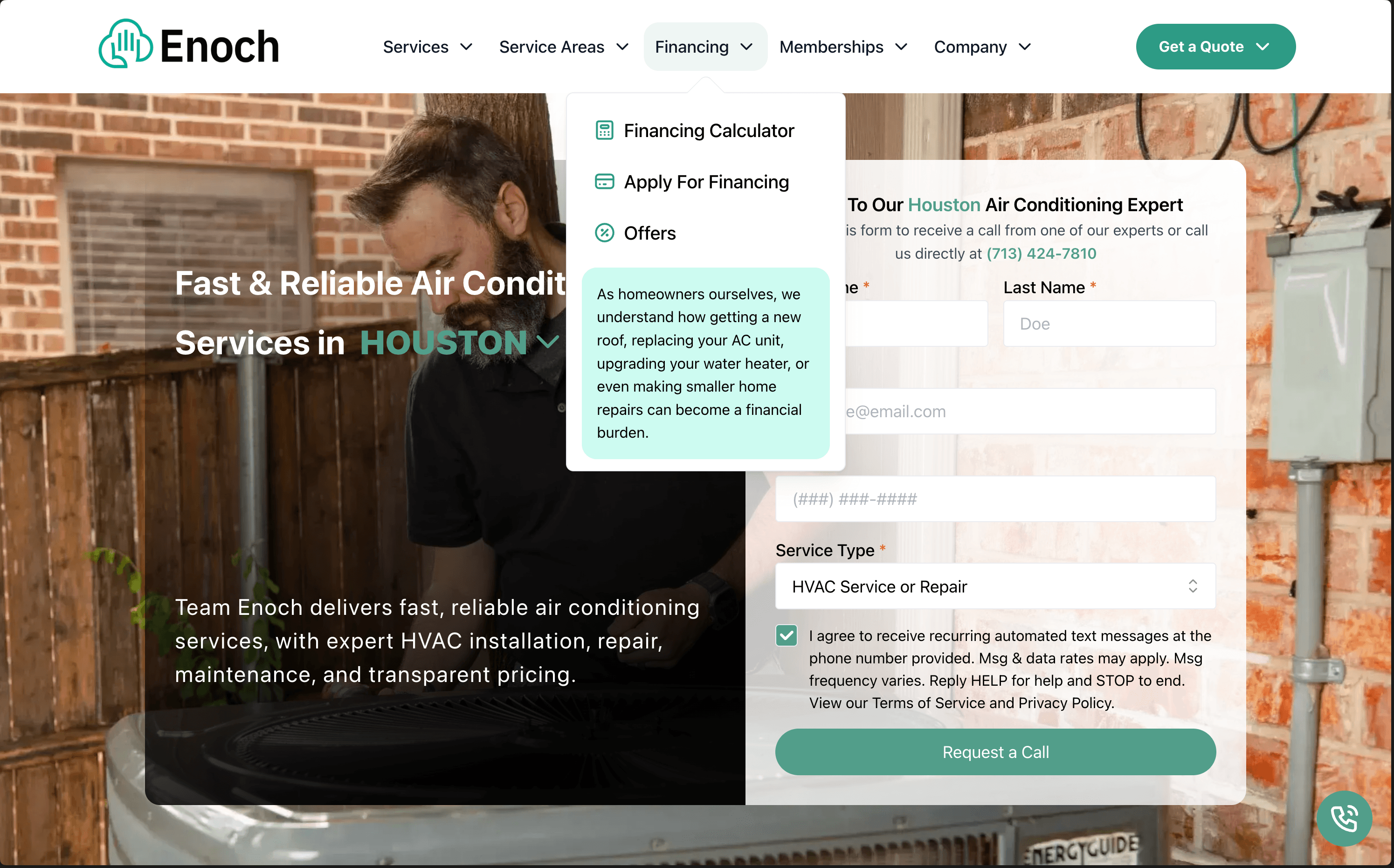
TeamEnoch.com — the public marketing site for a service business operating in HVAC, electrical, plumbing, and roofing.
Client problem #
Service businesses often run on websites that read as digital brochures rather than growth channels: slow loads, weak mobile experience, thin SEO, and content updates that require a developer every time. TeamEnoch needed to move past that — a professional digital presence that builds customer trust, ranks for the services it actually offers, and lets the business team update content without waiting on engineering.
Objectives #
The site was built to establish a professional online presence, improve search visibility, generate more customer inquiries, showcase services clearly, and stay easy to maintain — all on a performance baseline that holds up across devices, since a large share of service-business traffic is a phone search from someone who needs help now.
Process #
1. Content-driven architecture over a static site #
Frontend presentation, business content, service information, marketing pages, and media are kept as separate concerns rather than hardcoded into templates, so the site can evolve without a rebuild every time the business adds a service or location.
2. Headless CMS with Payload #
Payload CMS handles service pages, company information, testimonials, images, blog content, marketing sections, and contact details, giving the business team independent control over content while the design system stays consistent. Payload was chosen specifically for its flexible content modeling, TypeScript support, developer-friendly workflows, and more customizable admin experience than a traditional CMS offers.
3. SEO-first development #
Server-rendered pages, dynamic metadata, structured content, optimized URLs, sitemap generation, robots configuration, and Open Graph support were built in from the start — with each service page designed around a specific customer search intent (HVAC installation vs. HVAC repair, for example) rather than one generic services page trying to rank for everything.
4. Service-based content strategy #
Rather than a single "services" page, the architecture supports dedicated pages per offering — HVAC installation, HVAC repair, electrical, plumbing, roofing, maintenance — each with clear explanations, customer benefits, trust-building content, and a strong call to action. That structure does double duty: better SEO targeting and better on-page conversion.
5. Performance and mobile-first design #
Next.js rendering strategies, optimized images, a reduced JavaScript bundle, component-level optimization, and efficient asset loading keep the site fast, paired with a mobile-first layout (responsive design, touch-friendly navigation, optimized forms, clear contact actions) since urgent service searches skew heavily mobile.
6. Lead generation by design #
Prominent contact actions, service-focused navigation, inquiry forms, and trust-building sections run through every page, with each section built to move a visitor toward an inquiry rather than just informing them.
7. Reusable component system #
Navigation, hero sections, service cards, testimonials, contact sections, content blocks, and footer elements were built as a shared component library, so new pages (a new service, a new location) go out fast while staying visually consistent.
Technologies #
| Piece | Stack |
|---|---|
| Frontend | Next.js, React, TypeScript, Tailwind CSS |
| CMS | Payload CMS, GraphQL |
| Infrastructure | Server-side rendering, static generation, optimized image delivery |
Built for growth #
The CMS architecture leaves room for location-based landing pages, blog publishing, further service expansion, case studies, customer reviews, and marketing campaigns — the kind of content a service business adds incrementally as it grows, without needing a different platform each time. Security follows the same forward-looking approach: secure CMS access, protected APIs, input validation, and safe media handling.
Results #
Business impact. A stronger, more credible online presence, clearer presentation of services, and content the business team can update without developer involvement.
Technical. Faster page performance, better maintainability, and a content architecture flexible enough to grow with the business instead of requiring a rebuild.
Growth foundation. The site is positioned to support ongoing content marketing, SEO campaigns, new service pages, and customer-acquisition work as the business expands.
This describes the architecture and design intent behind the site rather than live traffic or conversion numbers, which weren't captured for public sharing here.
Outcome #
- High-performance Next.js website replacing a traditional, developer-dependent service-business site.
- Headless Payload CMS integration giving the business team independent control over services, testimonials, blog content, and marketing sections.
- SEO-first architecture with dedicated, search-intent-targeted pages per service line.
- Mobile-first, lead-generation-focused design built around getting visitors to inquire, not just browse.
- Reusable component system for navigation, service cards, testimonials, and content blocks.
- Content architecture built to absorb future location pages, blog content, and case studies without a platform change.
Lessons learned #
TeamEnoch.com reinforced that a business website isn't a digital brochure — it's a growth engine, and it should be built like one. Combining Next.js performance, Payload CMS flexibility, and SEO-first development produced a platform built for both immediate lead generation and long-term organic growth, and sharpened my experience designing production marketing sites and CMS architectures around real business outcomes rather than just page count.
Links #
- Live site: teamenoch.com
Related content
Clonify.io: Turning a Slow WordPress Marketplace into a High-Performance Next.js SaaS Platform
Rebuilding a digital-products marketplace from WordPress to Next.js and Payload CMS, with a custom JSON caching layer and secure, subscription-aware asset delivery.
Photo Pasal: Building Nepal's Modern Personalized Gift & Printing Platform
Turning a Messenger-and-phone-calls print shop into a scalable Next.js and Payload CMS e-commerce platform for personalized gifting in Nepal.
Teamenoch.com
Modern website platform for HVAC, electrical, plumbing, and roofing service businesses.